
Survey
YouGov: Strong opposition to bank financing of coal in Indonesia, Malaysia, and Singapore
A survey by YouGov has found that over 80% of people in Indonesia, Malaysia, and Singapore are concerned about climate change and strong opposition to bank financing of coal
A YouGov survey of 4,000 people across Indonesia, Malaysia, and Singapore has found overwhelming concern about climate change and strong, consistent opposition to bank financing of coal. The results reveal what consumers expect from their banks on coal financing, and how many are considering switching banks if those expectations are not met.
The survey, conducted by YouGov in March 2026 and commissioned by Market Forces, found:
- More than four in five people across all three countries are moderately to extremely concerned about climate change — Indonesia (96%), Malaysia (84%), and Singapore (81%).
- Around three in five people in each country agree that rapidly phasing out coal power is one of the best ways to tackle climate change — Indonesia (65%), Singapore (61%), and Malaysia (58%).
- More than seven in ten people across all three countries believe banks should not finance companies or projects that emit high levels of greenhouse gases — Singapore (73%), Indonesia (71%), and Malaysia (71%).
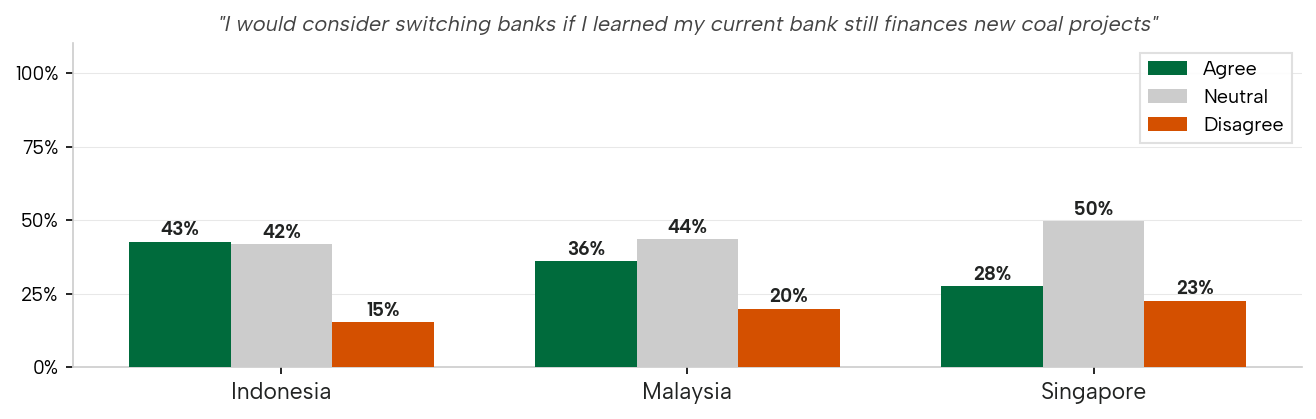
- More than one in three Indonesians (43%) and Malaysians (36%), and just under a third of Singaporeans (28%), would consider switching banks if they learned their bank still finances new coal projects.
- Around two in three people in Singapore (69%) and Indonesia (66%), and three in five Malaysians (59%), expect a bank’s commitment to end coal finance to apply to all coal plants — including industrial (captive) ones built to power facilities such as nickel and aluminium smelters.
- A majority of people in Indonesia (61%), Malaysia (54%), and Singapore (52%) do not consider nickel to be ‘green’ if it is produced using coal power.
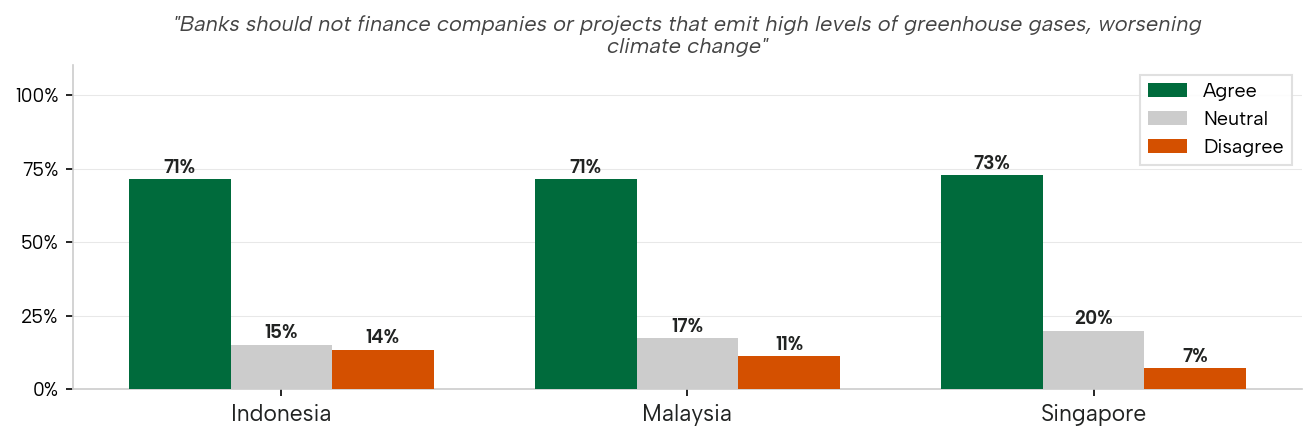
Public concern about climate change is high and broadly consistent across the three markets surveyed. This also correlates with specific expectations of financial institutions. More than seven in ten respondents across all three markets believe banks should not finance companies or projects that emit high levels of greenhouse gases — a finding that is consistent across Indonesia (71%), Malaysia (71%), and Singapore (73%).
A related question tested whether respondents attribute responsibility for climate change to banks: three in five people across all three countries — 63% in Indonesia, 61% in Malaysia, and 58% in Singapore — believe that banks that continue to finance coal are making climate change worse. These findings are consistent across markets with different economic profiles and regulatory environments, suggesting that the expectation for banks to exit coal financing is broad-based rather than concentrated among specific groups.
Captive coal: a gap in bank coal policy
Most bank coal exclusion policies are framed around coal mining and power companies. Captive coal — coal burned to power a company’s own industrial operations, such as nickel or aluminium smelters — is frequently outside the scope of these policies. This definitional boundary creates a gap: companies with substantial coal-fired captive capacity may fall outside existing bank coal policy frameworks even as that capacity grows.
The survey finds that consumers do not draw a distinction between grid-connected and captive coal when evaluating bank commitments. Around two in three respondents in Singapore (69%) and Indonesia (66%), and three in five in Malaysia (59%), expect a bank’s commitment not to finance new coal projects to apply to all coal plants — including industrial captive ones.
This finding also concerns the clean energy supply chain. Captive coal is used in the production of critical minerals — including nickel — that supply EV battery manufacturers. The survey finds that a majority of respondents in all three countries do not regard nickel produced using coal power as ‘green.’ This suggests that coal intensity in mineral supply chains may attract similar public scrutiny as coal-fired electricity generation.
Risk considerations for banks
The survey’s findings regarding customer retention have direct implications for banks’ risk assessment. A substantial portion of people in Indonesia (43%), Malaysia (36%), and Singapore (28%) would consider switching banks if they learned their bank still finances new coal projects. For banks with active exposure to coal-heavy companies, this represents a measurable reputational risk.
This shift in banking preferences is reinforced by specific trust signals in the survey. A majority of respondents across all three markets say they think more highly of banks that have stopped financing new coal projects — indicating that exiting coal carries positive reputational value for financial institutions. A significant share also says they do not trust banks that claim to have ended coal financing but continue to finance it — pointing to the credibility risk for institutions whose stated commitments are not matched by their financing behaviour.
Taken together, the survey results present a consistent picture across all three markets. Climate concern is high. Support for coal phase-out is the majority position. Expectations that banks should not finance coal are widespread and held consistently. People draw a direct link between bank lending and climate change. The consistency of results across Indonesia, Malaysia, and Singapore suggests a shift in public expectations that presents a material consideration for financial institutions.
Note to editors
The YouGov survey was conducted across 4,000 people in Singapore (1,000), Malaysia (1,000) and Indonesia (2,000) in March 2026. The poll was conducted among adults 18 years or older and representative by age, gender, socioeconomic status, ethnicity, and region — drawn from the general population in Singapore and Malaysia, and from the online national population in Indonesia. The YouGov survey was market weighted to reflect national population demographics. The survey consisted of 5-point Likert scale questions on climate concern, bank financing, and coal policy.
Join us
Subscribe for email updates: be part of the movement taking action to protect our climate.