
At APA Group’s 2025 Annual Meeting in Sydney, community leaders from the Northern Territory, climate scientists, doctors, and securityholders united to deliver one message the board could not ignore:
You can’t claim climate action or Paris-alignment while building pipelines that would unleash over a billion tonnes of emissions from the Beetaloo Basin.
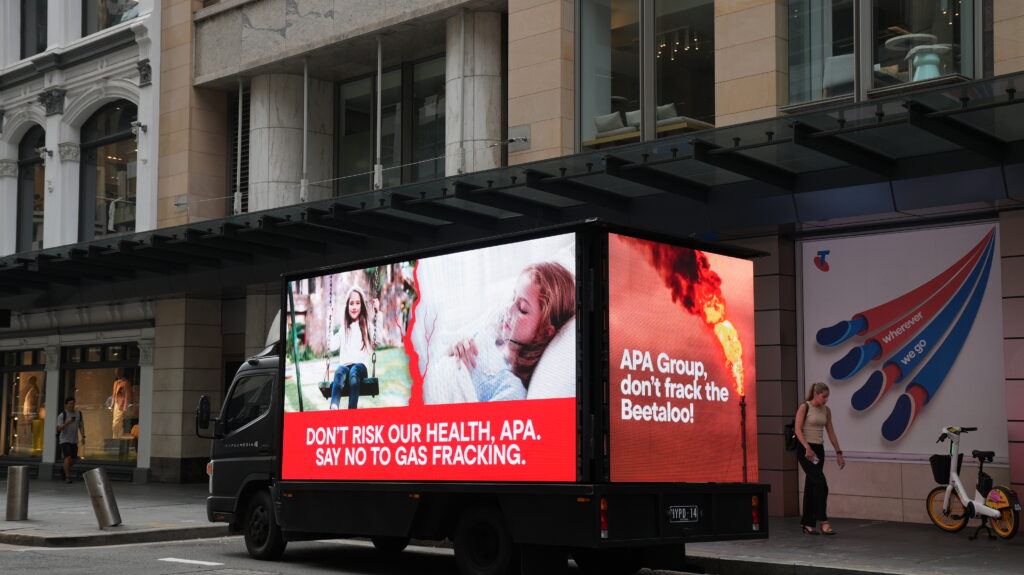
Outside the Annual Meeting, Market Forces projected this message onto a mobile billboard truck, circling the venue with messages reading:
“Don’t risk our water”
“Don’t risk our health.”
“APA Group, don’t frack the Beetaloo.”
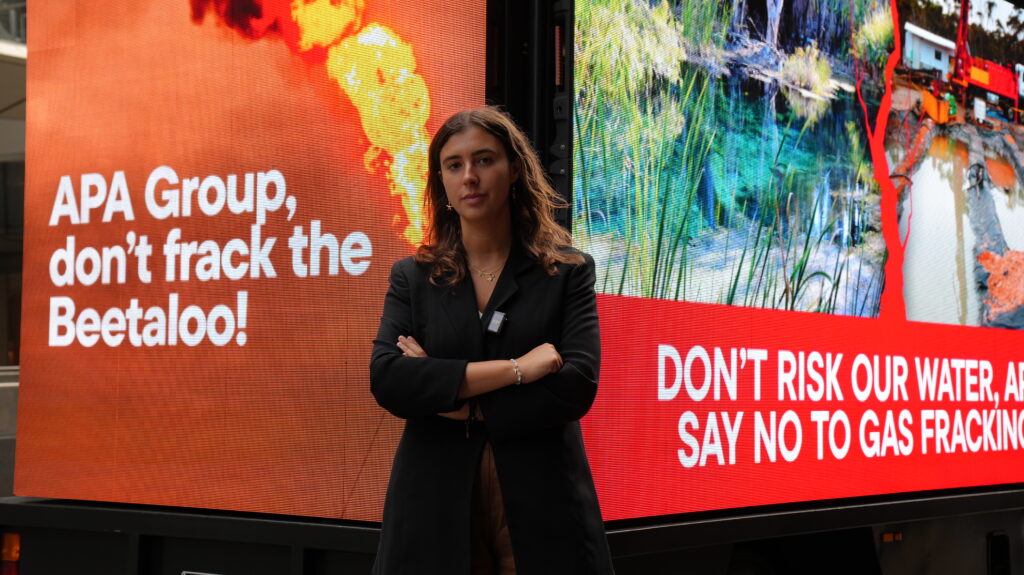
Inside the meeting, the same message rang through again and again, from scientists and community members questioning the Board on the floor as well as international investors voting in favour of our resolutions calling for climate accountability and due diligence on APA’s Beetaloo fracking partners.
“A carbon bomb in slow motion”
If fracking in the Beetaloo Basin proceeds, it could release over a billion tonnes of greenhouse gas emissions – more than 20% of Australia’s current annual emissions, if operating until 2070.
APA’s proposed pipelines would enable this carbon bomb, transporting gas from fracking wells through NT communities and aquifers toward export terminals.
At this year’s annual meeting, two resolutions filed by Market Forces demanded basic pre-FID (final investment decision) safeguards:
- Resolution 7C – calling for full disclosure of the lifecycle emissions from Beetaloo-linked pipelines and their compatibility with APA’s climate targets and support for the goals of the Paris Climate Agreement;
- Resolution 7D – requiring independent due diligence on APA’s fracking partners, Beetaloo Energy (formerly Empire Energy) and Tamboran Resources, both of which have troubling environmental and safety records.
Both resolutions won meaningful support — 15.7% and 9.8% of shareholder votes respectively — representing investors managing almost A$1.7 trillion in assets, including major global public sector and pension funds.
Inside the room: key moments
Science versus spin
“We cannot stay underneath 1.5°C with any, and I mean any, new fossil fuel infrastructure. Beetaloo is a carbon bomb.”
– Professor Lesley Hughes, former IPCC lead author
Video: Professor Lesley Hughes challenges APA Group on the incompatibility of the Beetaloo Basin gas project with a climate safe future.
Renowned climate scientist Professor Lesley Hughes directly challenged APA’s claim that it supports the goals of the Paris Climate Agreement. The chair responded by stating gas would continue to be required until 2050 under different IPCC scenarios, and argued that new gas developments aligns with current federal government policies.
But Professor Hughes’ point was clear and irrefutable: the IPCC and IEA both confirm that existing fossil fuel infrastructure already exceeds the 1.5°C carbon budget. No new oil or gas can fit within that limit. Professor Hughes powerfully urged the APA Board not to hide behind government policy, and to take genuine responsibility for aligning with climate science.
Don’t turn the NT into a sacrifice zone
“[The Mataranka Springs] is our water source, it’s our culture, it’s our tourism, and it’s really our livelihoods.”
– Dr Megan Pickering, Katherine veterinarian and academic, Protect Big Rivers
Video: Dr Megan Pickering travelled from Katherine, NT to tell the APA Board about the deep concerns of remote community members, and how fracking will threaten the community’s water source.
Veterinarian and long-time Katherine resident, Dr Megan Pickering delivered one of the most powerful statements of the day.
Representing the Protect Big Rivers alliance, she described how communities rely entirely on groundwater from the Cambrian Limestone Aquifer, which fracking threatens to deplete and contaminate, as the NT already suffers from intensifying heatwaves and droughts.
Dr Pickering also brought handwritten letters from her community, penned by landholders and residents around Katherine who could not afford to travel to Sydney. Their message was simple: We want to be heard. We rely on this water to live.
She asked the Board whether APA would accept responsibility for safeguarding the Mataranka Springs and commit to binding clauses that suspend gas transport if groundwater triggers are breached. The Chair refused, replying only that APA would comply with whatever conditions are imposed if development approvals are granted.
When Dr Pickering told the room that the NT Government had “rammed through” the Territory Coordinator legislation that allows a single unelected bureaucrat to override local consent, the CEO insisted APA’s engagement had been “commended” by the Northern Land Council.
Dr Pickering countered with the reality of communities on the ground:
“I was in a community meeting in Katherine on Sunday with NLC members who said they knew nothing about what you’re talking about.”
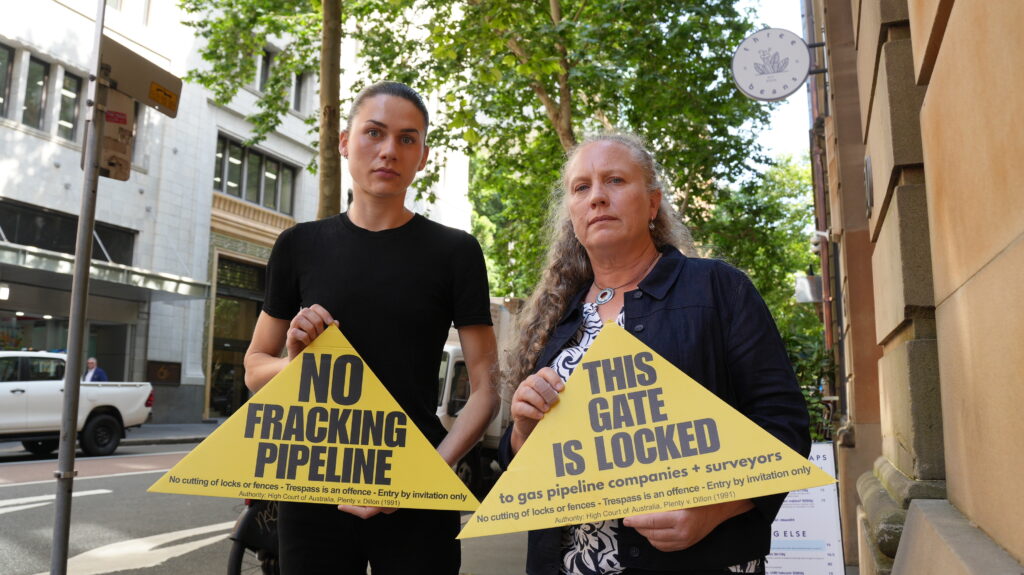
Community members from the Northern Territory travelled to address APA Group’s board at its Annual Meeting in Sydney.
Holding the evidence in hand
“Would you grow your vegetables in this? If it’s not good enough for you, why is it okay for NT communities?”
– Angelica Mantikas, Market Forces Gas Campaigner
Video: Market Forces Gas Campaigner Angelica Mantikas questions the board on the long term contamination risks of fracking in the Beetaloo basin.
Market Forces’ Angelica Mantikas spoke on behalf of more than 100 securityholders supporting the resolutions. Ms Mantikas asked the board if they were “at all concerned about the potentially major adverse impacts such as climate, environmental, cultural, agricultural and economic that may not ever be possible to remediate.”
Holding up a soil sample collected by independent scientist Professor Ian Wright from near Beetaloo Energy’s Carpentaria-5 spill site, Ms Mantikas told the board the soil sample was taken from an area where Traditional Owners still live off the land. Professor Wright found elevated heavy metals, nutrients, and radioactivity – and warned of a contamination chain reaction that could last generations.
Ms Mantikas challenged the board’s repeated assurances that fracking is safe if properly regulated and raised concern about APA’s upstream partners. The Chair dismissed the example, claiming most incidents were “self-reported” and had caused no material environmental harm – relying on government approvals and processes that have fallen short thus far to protect certain areas, such as the Carpentaria-5 spill site.
The exchange drew audible frustration from the room. Community advocates later described the exchange as emblematic of the industry’s “culture of denial”.
Health experts demand accountability
“How can APA proceed with a project related to the Beetaloo project in good faith, knowing these harms? Is this deemed just a necessary cost of doing business?”
– Dr Anthony Hull, Doctors for the Environment Australia
Video: Dr Anthony Hull advised the APA Board about the health risks for populations living near fracking wells and pipelines.
Dr Anthony Hull cited peer-reviewed international studies linking proximity to fracking wells with severe health impacts – including higher rates of leukaemia for children who live near fracking wells and pipelines, low birthweight and premature births, birth defects, asthma, and increased severity of chronic disease. Studies also show higher rates of premature death for populations that live near gas and oil projects internationally. Dr Hull stated, “I’m providing this information based on robust, accepted, and recent medical evidence.”
Despite this, the chair again relied on selective sources and claimed that “the evidence simply isn’t there that it’s dangerous” He also assumed that the health impacts raised by Dr Hull would be addressed during the project’s approval processes.
Dr Hull directly challenged this, pointing out that Australian regulation does not assess health impacts at all – a major gap that leaves affected communities unprotected.
What investors said with their votes
| Item | Resolution | For | Against | Abstain | Outcome |
| Advisory vote | Climate Transition Plan | 89.8% | 10.2% | 91.8m | Significant dissent |
| 7C | Beetaloo emissions & Paris-alignment disclosure | 15.7% | 84.3% | — | Strong pre-FID support for disclosure |
| 7D | Due diligence on Beetaloo Energy & Tamboran | 9.8% | 90.2% | — | One in ten backed transparency |
Institutional investors including New York City Pension Funds, CalPERS, KLP, and Storebrand publicly endorsed the call for basic transparency and risk assessment before APA commits billions to Beetaloo pipelines.
Fact check: APA’s claims vs reality
| APA claim | Reality |
| We’re aligned to Paris because we comply with the Safeguard Mechanism. | Compliance with domestic policy ≠ scientific alignment. The IPCC and IEA both confirm: no new oil or gas fields fit within a 1.5°C pathway. |
| Fracking is completely safe if properly regulated. | In the Beetaloo, 30+ environmental incidents have already been recorded in the exploration phase. The NT’s Pepper Inquiry said fracking could only be “safe” if all recommendations were implemented - yet fewer than half have been, and many only on paper. |
| It’s too early to disclose emissions, we’ll do it after approvals. | Pre-FID is when investors need this analysis. Once capital is sunk, communities bear the cost. Resolutions 7C and 7D asked for the bare minimum: evidence-based due diligence before greenlighting the project. |
Communities lead – investors follow
This annual meeting showed that scientists, community leaders, and investors are closing ranks. The board’s refusal to answer simple questions on climate, water, and consent has left APA isolated from both its communities and a growing number of shareholders.
From the room to the streets, people are demanding one thing:
- Stop enabling Beetaloo fracking.
- Protect our water.
- Protect our health.
- Protect our climate.
- Protect our future.
Take action
Join thousands calling on APA to rule out building pipelines that would enable fracking in the Northern Territory.
References:
- IPCC AR6 Synthesis Report 2023 – Headline Statements (https://www.ipcc.ch/report/ar6/syr/resources/spm-headline-statements/ )
2.[IEA Net Zero by 2050 Roadmap (2023 update) (https://www.iea.org/reports/net-zero-by-2050 )