
AustralianSuper is the largest super fund in Australia, managing $367 billion in retirement savings on behalf of more than 3.5 million members. Unfortunately AustralianSuper is now the second-largest shareholder in Whitehaven Coal, which has the biggest coal expansion plans of any coal company operating in Australia.
AustralianSuper has recently invested more than $300 million of its members’ retirement savings in one of Australia’s worst climate wreckers, Whitehaven Coal, making a risky bet on an unsafe climate future.
AustralianSuper had previously divested from Whitehaven on climate grounds back in 2020, claiming at the time that this was “good investment practice.”
Yet the fund has backflipped on this position and recently started buying up Whitehaven shares like the coal industry is going out of fashion (spoiler alert: it is), acquiring more than 60 million shares in this climate wrecker so far this year.
Until recently, Whitehaven primarily mined thermal coal – which is burned for energy production – historically generating around 94% of its revenue from this highly-polluting fossil fuel. But as global financial markets have been increasingly shunning thermal coal miners like Whitehaven, these climate wreckers have been attempting to put a new spin on their same old polluting business practices.
In Whitehaven’s case, this looks like ‘diversifying’ its revenue stream by mining and selling… a different type of coal. This is clearly (not) a company with a long-term vision for a clean energy future!
Climate science and energy experts are clear: there can be no new coal mines or mine expansions – thermal or metallurgical – if we are to have a shot at meeting the climate goals of the Paris Agreement.
AustralianSuper’s massively increased stake in Whitehaven is at odds with the fund’s stated support for the Paris climate goals, raising concerns about greenwashing. Worse still, a large investor like AustralianSuper buying up such a big stake in Whitehaven could actually make it easier for the company to pursue its highly-polluting coal expansion plans!
Unless AustralianSuper is using its near 10% stake in Whitehaven to demand an end to the company’s polluting coal expansion plans, there can be no justification for such a massive backflip on one of Australia’s worst climate wreckers.
Take action!
Submit a formal complaint to AustralianSuper and demand answers about its recent investments in Whitehaven.
Note: This will be sent to AustralianSuper’s complaints department.
AustralianSuper: climate castaway
If there’s one thing AustralianSuper isn’t good at, it’s reading the room when it comes to the issue of climate change. Not only is the fund now the second largest shareholder in Whitehaven, but it is also among the top three shareholders in Australia’s biggest oil and gas company Woodside. Unlike a lot of its peers, AustralianSuper’s 2050 portfolio emissions target excludes the majority of fossil fuel companies’ emissions and the fund has no policy excluding investments in coal companies.
Yet AustralianSuper gladly sang its own praises when it divested a small parcel of Whitehaven shares worth $3.6 million back in 2020, on climate grounds. At the time, AustralianSuper’s ESG Director Andrew Gray said that the fund had “a very integrated approach to managing climate in investments,” and that as a result, “currently AustralianSuper does not have any active investment in thermal coal companies.”
Fast forward five years – now halfway through the critical decade for climate action – Whitehaven has doubled down on its polluting expansion plans and AustralianSuper has a stake in this company worth more than $400 million (greater than 100 times the value of its 2020 investment) at the time of writing. To make matters worse, the fund continues to perform some incredibly clumsy semantic gymnastics in attempting to convince the world that this investment is somehow consistent with its climate commitments.
Climate science and energy experts are clear: no new coal
Thermal coal is continuing to play a declining role in our global energy system, as one of the most polluting and expensive forms of energy generation. But this hasn’t stopped AustralianSuper from trying to justify its recent investments in Whitehaven with its usual spin.
When questioned by The Guardian about its increased stake in Whitehaven, an AustralianSuper spokesperson said: “The energy transition is not linear, which means thermal coal will be an important stabilising source of electricity for the grid for some time to come, both domestically and overseas.”
It’s curious to note that, unlike in 2020 when AustralianSuper was patting itself on the back for thermal coal divestment, the above comment is attributed to an AustralianSuper ‘spokesperson.’ It’s as if no one at the fund was comfortable risking their professional reputation on such an appalling organisational position, knowing these kinds of comments aren’t likely to be very well received halfway into this critical decade for climate action.
Contrary to what AustralianSuper claims, climate scientists and energy experts are in agreement that there is one clear direction coal production and use must go if we are to meet global climate goals: down, and quickly.
The Intergovernmental Panel on Climate Change (IPCC) has concluded that limiting global warming to 1.5°C means nearly all of the world’s coal reserves cannot be burned, denoting that some existing mines will need to close before their planned end of life. Similarly, the International Energy Agency (IEA) has also projected that coal demand will decline in all of its forward-looking climate scenarios. This includes its ‘stated policies’ (STEPS) scenario, which assumes no further climate policy ambition from governments around the world and would result in a catastrophic 2.4°C of warming!
The below chart compares Whitehaven’s thermal coal production plans with the IEA’s three key scenarios. The darkest green line (NZE 1.5°C) is the projected coal production under a scenario in which the world reaches net zero emissions by 2050 – what AustralianSuper claims to support – and keeps global warming to 1.5°C above pre-industrial levels.
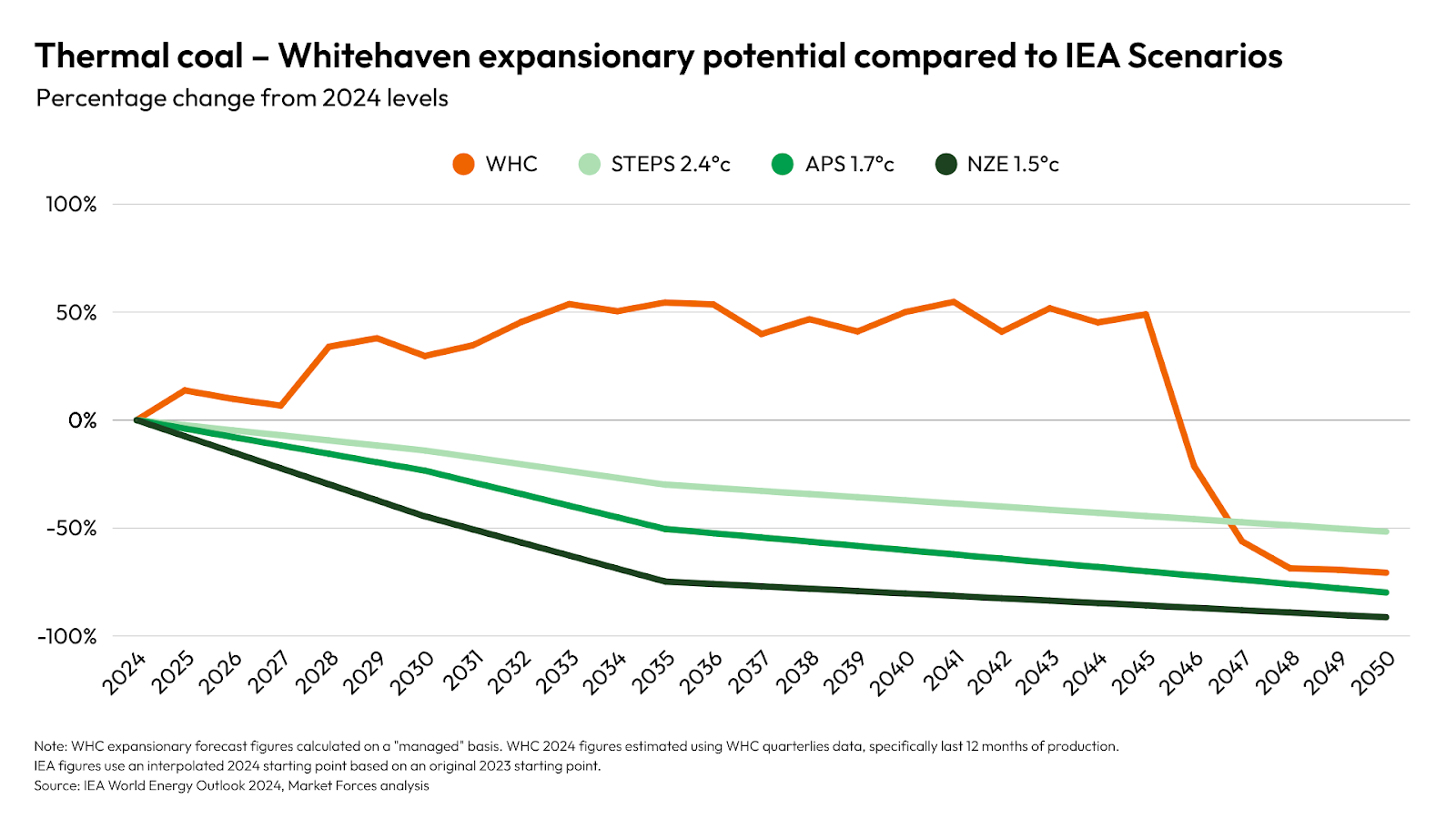
Compare that with the orange line (WHC) which represents Whitehaven’s production plans. The transition to net zero may not be “linear” as AustralianSuper puts it, but it certainly won’t be heading in the wrong direction for the next 20 years!
As the above chart also demonstrates, Whitehaven’s thermal coal expansion plans aren’t even compatible in a world that has warmed by 2.4°C. Climate science is clear that every fraction of a degree of global warming matters, with higher warming scenarios posing an exponentially greater threat to a stable climate, a stable economy and therefore super fund members’ returns.
AustralianSuper: ‘no new coal’ also applies to metallurgical coal
To justify its recent investments in Whitehaven, an AustralianSuper spokesperson said: “Whitehaven’s acquisition of BHP’s metallurgical coal assets changed the company’s revenue profile and made it a more attractive investment given their importance in steel making.”
Again: “no new coal mines or coal mine lifetime extensions” – including metallurgical coal mines – can go ahead if we are to have a shot at meeting the climate goals AustralianSuper claims to support.
Luckily for AustralianSuper, we’ve also produced a chart demonstrating how far out of line Whitehaven’s metallurgical coal expansion plans are with the IEA’s key scenarios. As shown below, Whitehaven’s metallurgical coal growth plans rise sharply and peak at more than 150% above 2024 levels in the early 2030s, while coal production falls by nearly half under the NZE (1.5°C) scenario over the same timeframe.
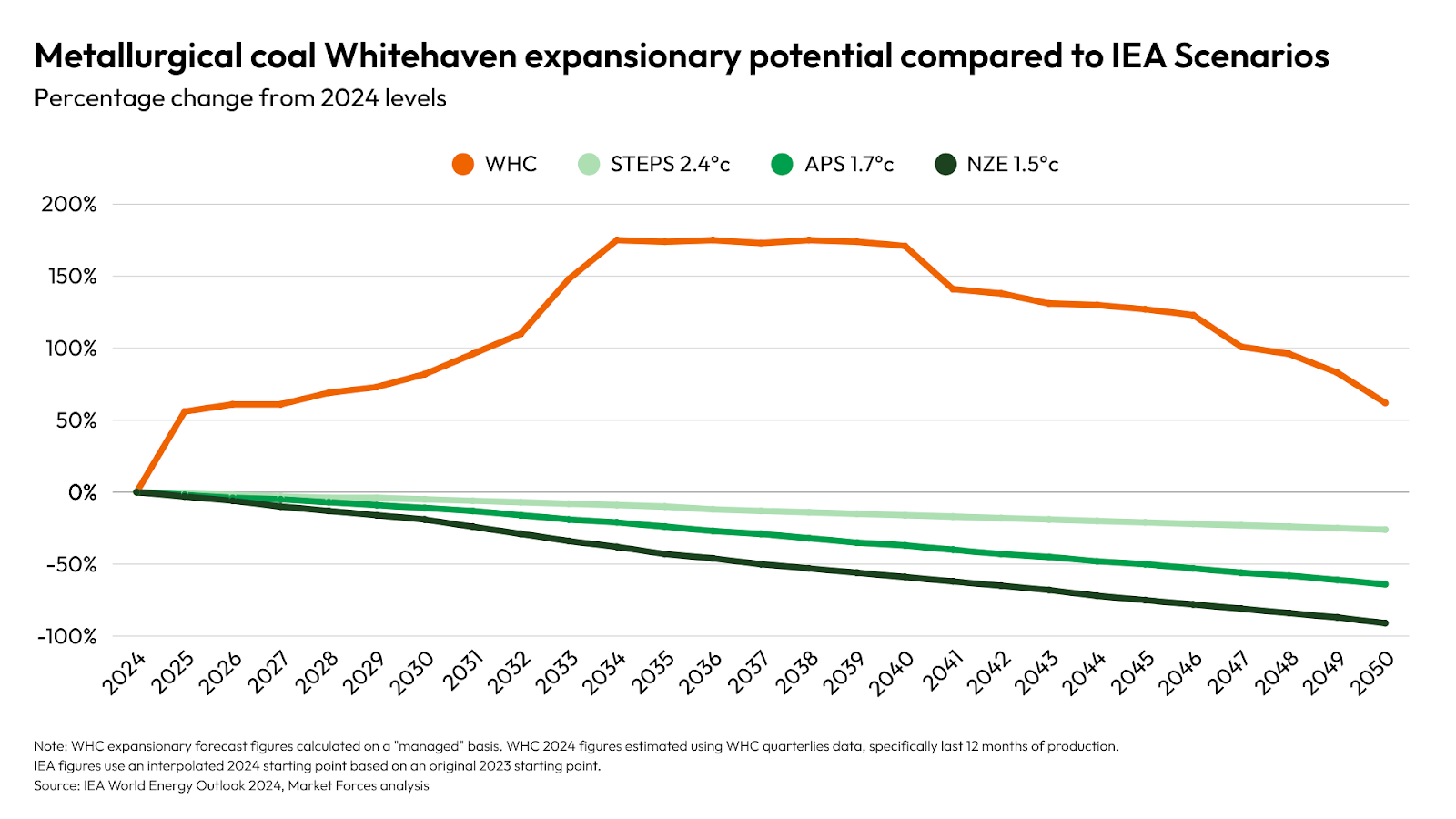
No matter how AustralianSuper tries to justify this massively increased stake in Whitehaven, the bottom line is that any company with plans to develop new or expanded coal mines – thermal or metallurgical – is undermining the global energy transition and fuelling the climate crisis. Whitehaven’s expansion plans are fundamentally incompatible with AustralianSuper’s stated commitment to its “long-term goal of net zero by 2050.”
This shouldn’t be a difficult concept for Australia’s largest super fund to grasp. As demonstrated by the above charts, Whitehaven is aiming its business in the opposite direction to the climate goals of the Paris Agreement. In fact, Whitehaven has even mocked the idea of climate scenario modelling in a publication of long-term thermal coal price forecasts, referring to the 1.5°C outlook as the ‘Greedy Governments’ scenario.
AustralianSuper’s argument that Whitehaven is a good investment because it has a “majority business exposure to metallurgical coal” doesn’t hold any credibility on the basis of the company’s thermal coal expansion plans alone, before we even consider its metallurgical coal growth plans on top.
AustralianSuper’s options with Whitehaven: wind up or get out
AustralianSuper has two options when it comes to Whitehaven: use its leverage as a major investor to urgently deliver a Paris-aligned ‘managed decline’ strategy from the company, or failing that, dump its shares.
Large investors like AustralianSuper that claim to support the Paris climate goals must take action in order to preserve the value of their portfolios and avoid scrutiny for greenwashing, when a company like Whitehaven demonstrates it has no intention of aligning its business plans with global climate goals.
Whitehaven’s coal expansion plans could result in nearly five billion tonnes of carbon pollution from burning coal, equivalent to running all of Australia’s coal-fired power stations until 2062. These emissions are avoidable if Whitehaven ends its coal growth plans, meaning emissions from any new or expanded coal project Whitehaven approves will sit largely on the shoulders of major investors like AustralianSuper.
Market Forces analysis has demonstrated that Whitehaven’s coal growth strategy is extremely fragile, with the company risking significant value destruction for investors even under minor fluctuations in coal prices. Any investor left holding this toxic company must take this into account, particularly long-term investors like AustralianSuper with legal obligations to understand and manage climate risk.
AustralianSuper’s Chief Investment Officer Mark Delaney recently said: “When we build retirement portfolios for people, there are two things in their minds. The first is, how can we make as much money as possible for a decent retirement? And the second one is to have a journey to get to that retirement that is not so volatile.”
AustralianSuper’s massively outsized stake in Whitehaven is nothing if not a reckless bet on a volatile journey. Delivering a managed decline strategy from Whitehaven could be a major opportunity for AustralianSuper to both live up to its climate claims and support a “decent retirement” for its members.